StatCounter, a company specialized in analytics, just released their global August 2025 report that contains multiple market share statistics related to tech and the web. Among those reports, StatCounter releases a Desktop Operating System Market Share report, and the August 2025 report contains some good news: the Linux desktop market share reaches 11% in France.
A first in history
It’s the first time Linux has this much popularity in the desktop field here in France. Of course, Linux already “wins” in a lot of fields, especially for smartphones (Android). But it’s the first time since the StatCounter reports were published (January 2009) that it has reached this point. Before August 2025, the highest market share ever recorded in France for Linux was in July 2009, reaching 6.3% back then. We can also see how Windows and macOS lost part of their respective market share in favor of Linux and other operating systems.
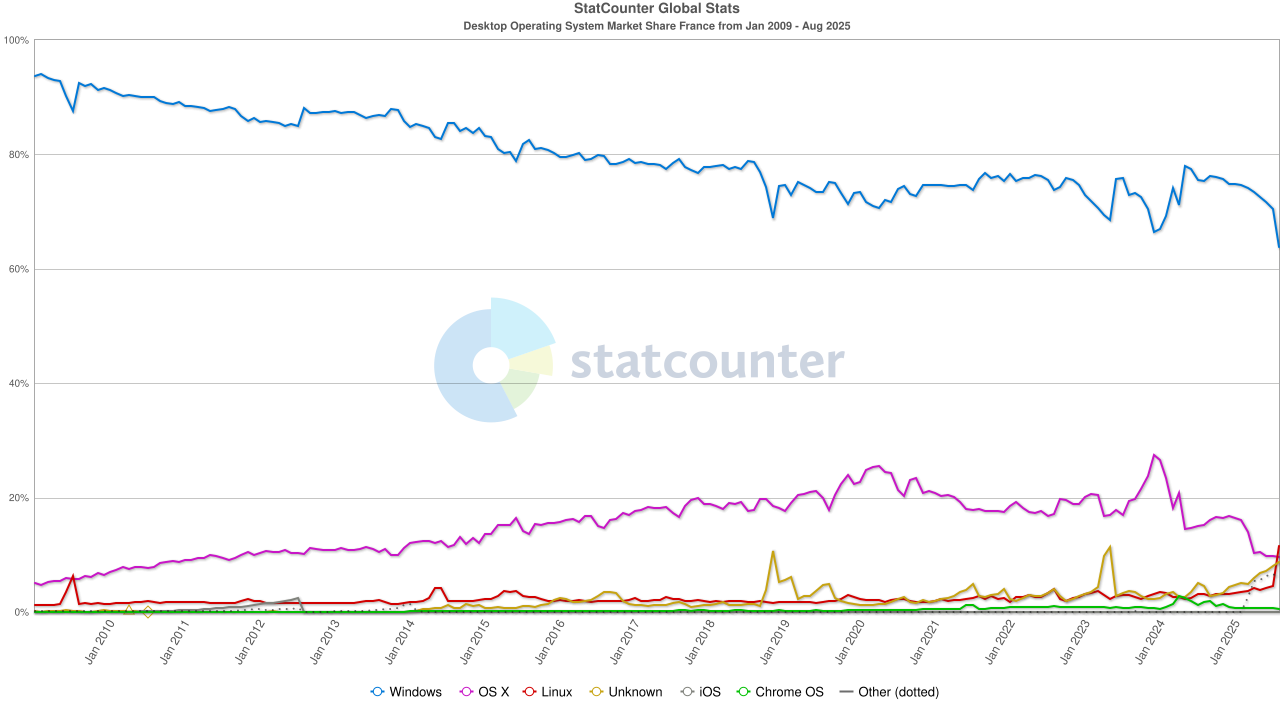 The Operating System market share graph in France since January 2009, StatCounter
This number could actually be way higher
The way StatCounter makes these reports is by analyzing web traffic to determine device information such as the screen resolution, language, browser, and the operating system running on the visitor’s machine. The thing with Linux is that it runs in a lot of different ways, especially due to the insane number of Linux distributions, with some of them altering headers sent to web pages for privacy reasons, or just for the sake of it. This could explain why the “Other (dotted)” and “Unknown” operating systems have an increasing market share.
Why now?
There are multiple reasons that come to mind regarding this situation. Of course, none are “official.”
1. Because Windows 11 sucks
It’s as simple as that: Windows 11 simply sucks, and people are starting to realize it. Multiple questionable features were integrated into Windows 11, like Windows Recall that records your computer constantly to “help” you (and also help them, by selling your juicy data to train AI models), the introduction of an insane number of ads, extensive tracking, UI inconsistencies, and much, much, more. Microsoft is openly throwing trash at everyone’s faces and they know they can get away with it easily.
2. Windows 10 is reaching its EOL (End Of Life)
Windows 10 support is set to end on October 14, 2025, forcing a lot of users to switch to Windows 11, and Windows 11 sucks, so people are looking for alternatives.
3. The Linux desktop keeps getting better
With the huge choice of distributions available, there is little to no chance for you not to find a distribution that corresponds to your needs. The main issue with Linux desktops was gaming, which stops a lot of users from installing Linux over Windows, because let’s be honest, there is still a lot of work left to make the Linux desktop gaming experience the same as you can get on Windows.
It’s getting better, though, and some distributions are aimed at providing an insanely good gaming experience on Linux, like GLF, and a lot more (I’m not able to recommend one as I am not a huge player of video games), but it’s still not as close as the support you get on a Windows installation, mostly because of kernel-level anti-cheats and sponsorships. Most of the work done to bring gaming to the Linux desktop is thanks to Valve, which chose Linux to run its Steam Deck device, causing them to develop Proton in cooperation with CodeWeavers, maintainers of Wine.
Other than that, Linux desktops are strong, fast, reliable, and better support old hardware. You can do everything you are already doing just fine without the hassle Windows brings.
We have a bright future ahead of us
Linux is getting better and better while the hate for Windows grows stronger and stronger, and this is clearly shown here in France as the report shows. I want to end this article by showcasing great initiatives to ditch Windows taken at a large scale.
The French government is massively investing in Open Source projects and Linux
Yes, the French government is actually doing something good (it’s rare that I need to mention it when it’s the case). After understanding that using only proprietary software to run the country was not sustainable and ethically correct, the inter-ministerial IT department (la Direction Interministérielle du Numérique) decided to create the Open Source and Digital Commons Hub (le Pôle Open Source et Communs Numériques) to assist government agencies in increasing their use of Free and Open Source software and supporting their efforts to publish source code.
The French government also started in 2008 to develop GendBuntu, an Ubuntu-based distro to use for the French Gendarmerie (law enforcement unit). It is still maintained and used today, with 97% of workstations (over 100,000) running GendBuntu.
Linux in education
French universities are shifting towards Fedora Linux for specific diplomas (such as the BUT Informatique (Bachelor’s Degree in Computer Science) and the BUT MMI (Bachelor in Multimedia and Interactive Design)) since a few years ago.
For primary schools, a free and open source Linux distribution called PrimTux was made, which is maintained by teachers. Since 2023, the French Ministry of Education (le Ministère de l’Éducation Nationale et de la Jeunesse) as well as the interministerial IT department (la Direction Interministérielle du Numérique) have been allocating funds to maintain the project. Since 2024, it has been heavily recommended to primary school teachers and directors by the French Ministry of Education.